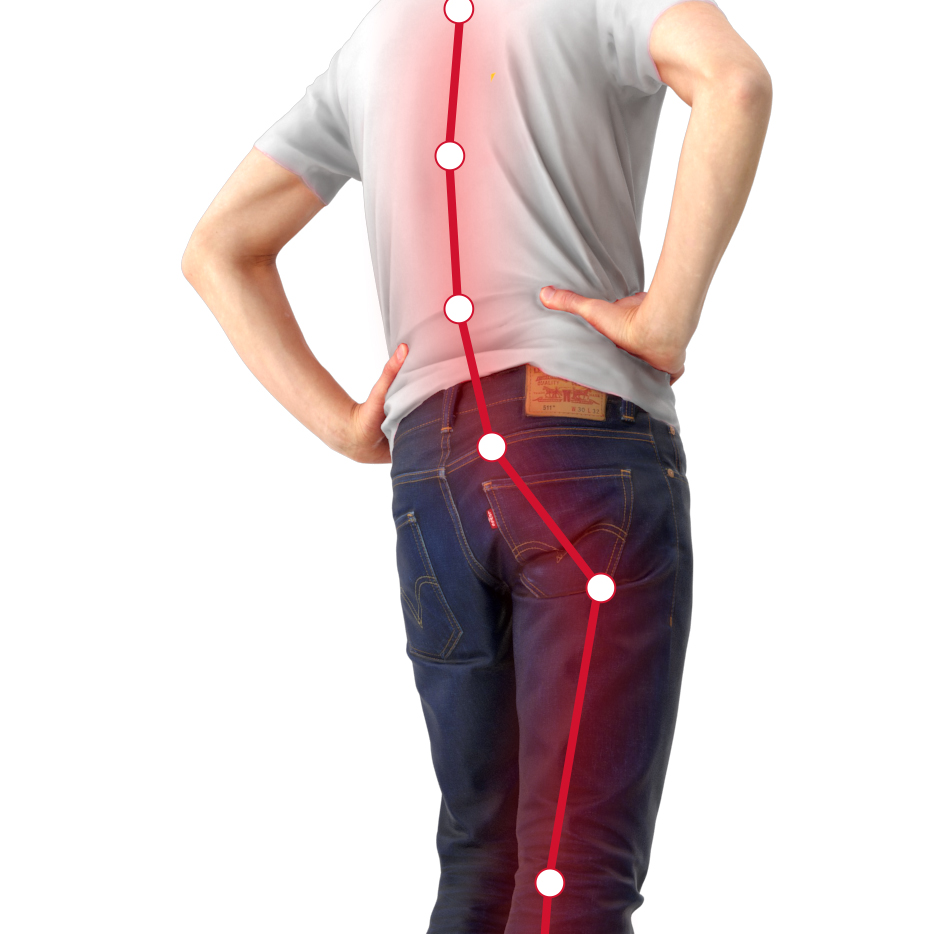
Sciatica is a symptom caused by lumbar disc herniation and the pain generally affects the back, hip and leg. In such a case, the disc between two lumber vertebra compresses over existing nerve roots and causes radicular pain in one or both legs. It results in the patient experiencing tingling, numbness and stretching kind of pain in either one or both the legs. The pain can radiate up to toe, fingers and ankle however sometimes pain may only radiate up to the thigh and above knee.
What Are Sympotoms Of Scitiaca ?
Tingling and numbness in one or both legs
Ant walking sensation
Radicular pain in leg
Pain increase by walking and standing
Partially or completely relieved by rest or lying down position
Pain may provoke by coughing, sneezing or any kind of straining
How Sciatica Is Diagnosed ?
History and physical examination can give clues to suspect sciatica. X ray and MRI of lumbar
spine can help to diagnose sciatica as well as help to find out causes of it. MRI also guides a treatment plan.
What Are Treatment Options For Sciatica ?
Back pain management often includes short-term drug therapy and guided physiotherapy. Painkillers and anti-inflammatory medicines can help reduce pain and swelling in the early stages, making movement easier.
Conservitive
For acute and less severe pain, rest and medicine can help few of patients. Avoiding forward bending, lifting weight,
avoiding sitting on floor will help. If patient feels improvement in pain we can continue a conservative approach with
medicine and exercise for four weeks.
Interventions
If exercise and medicine are not working than your doctor might suggest you some intervetions. Pain Management treats such diseases with techniques called intervention. Intervention is a small injection technique which helps to get rid of root problem of Sciatica without surgery. Your doctor will see all reports and then suggest you best treatment options for you.
Transforminal Block
Mild bulge (Slipped) Disc can cause a swelling on the existing nerve roots. Injecting a drug in to a foramen will reduce that swelling inside and help the patient by dissipating the pain.
Transforaminal Block is given under local anesthesia. It is given under live X-ray (C arm) guidance. Here we numb a part of the back
and insert a thin needle inside. The needle is guided with the help of a Live X-ray Machine.
WHAT TO EXPECT AFTER THE PROCEDURE?
Mild aching back, which will be relieved with medicine.
Improvement in pain will start after two to three days.
It is recommended that patients apply ice on the back for three to four days.
Patient must take rest for 1 to 2 days although no complete bed rest is required.
Advantages Of This Procedure
Get rid of Sciatica problem without surgery
Remove a part of disc
Procedure done under local anesthesia so we can avoid general anesthesia
No bed rest needed
Less post-operative pain
Short recovery period
Get results equal to surgery
Provide a disc sample for biopsy if required
Intense rehabilitation not required
Avoids surgery and consequences of surgery
No scarring after procedure
Cost effective due to reduced hospital stay
Can be done on elderly patients also
Surgery
Laminectomy is an open surgery performed to relieve excessive pressure on the spinal cord and nerve roots caused by conditions like severe stenosis.
In this procedure, a part of the vertebra called the lamina is removed to create more space, helping reduce pain, numbness, and nerve compression.
Laminectomy
Sometimes due to severe Stenosis or loss of sensation in the leg / legs, the patient is required to go for an open surgery called Laminectomy. Laminectomy should be done under general anesthesia. Laminectomy is a surgery done to remove excessive pressure on the spinal cord and nerve roots. Laminectomy removes a portion of thin part of vertebra called lamina which forms a protective arch of vertebra. Laminectomy also removes a thick part of tissue around spinal cord on selected vertebra